Lunch & Learn | Thursday 15 October | 12:15–13:00 CEST | Online
Water availability is coming under increasing pressure. Climate change is bringing more extreme droughts and rainfall, while demand for water keeps growing. Water quality is also becoming more critical for nature, public health, safety and economic prosperity. Tackling these wicked challenges calls for collaboration where the institutional barriers are crossed. An intense collaboration between governments, businesses, knowledge institutions, local communities and nature is called for.
In this Lunch & Learn, the Institute for a Circular Society (i4CS) looks at the Brainport region. There, partners are exploring the transition from linear water use to a circular, regenerative water system, in which water is reused and shared among multiple users before it returns, regenerated, to the environment.
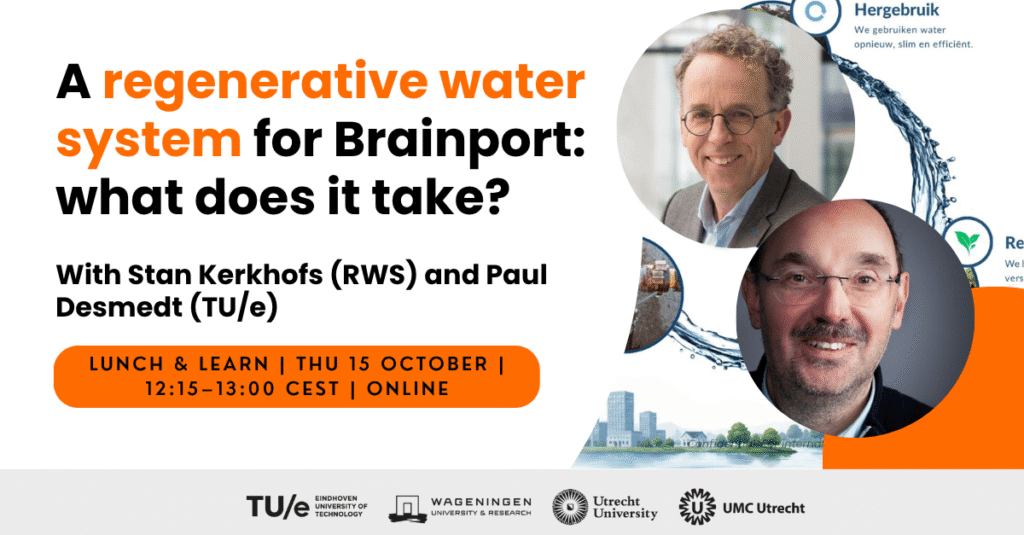
Stan Kerkhofs, Living Lab Specialist at Rijkswaterstaat, explains how Rijkswaterstaat is rethinking the role of its assets. Today, a motorway serves a single purpose, and roads often disrupt nature and water. The ambition is for motorways and canals to also serve water, housing and energy. A canal, for instance, could store water from one season to the next instead of only carrying ships. In the pilot area of Brainport Northwest, plans include decentralised water treatment and linking water demand and supply between Defence, industry and the motorway. At the InnovA58 Kloosters test site, a living lab, they are experimenting with water storage, treatment, reuse and controlled groundwater infiltration, so that innovations can be tested, validated and prepared for deployment.
Dr Paul Desmedt, Program Manager Livable Region at Eindhoven Engine, presents the 4th university side. Eindhoven Engine connects research and relevant institutes to real-world implementation by bringing regional stakeholders together. Eindhoven Engine functions as orchestrator for the water management problem. To develop alternative water management systems, the team combines multistakeholder analysis, system dynamics, climate forecasting, system controls and both chemical and natural purification methods. Together with the Open Innovation department at TU/e, Eindhoven Engine has also set up a learning community. It records the lessons learned along the way, so that other regions can use them in their own transitions.
Technology is only part of the answer. For Rijkswaterstaat, the transition also means working in shorter chains and with a more collaborative attitude. Stan brings an open question to the research community as well: how can ecological and social value be made visible, so that it counts in governance decisions alongside financial value?
After two short presentations, moderator Sacha Tensen, Program Manager Circular Regions, talks with both speakers about the vision, how their collaboration came about, current initiatives and the questions that remain. If your research touches on these questions, or you see opportunities to work together, you are invited to join the conversation via the chat.
Practical information
📅 Thursday 15 October
🕛 12:15–13:00 CEST
💻 Online, in English
🎥 The session will be recorded and shared afterwards via YouTube and the i4CS newsletter