Why do some people eat more vegetarian meals, buy less-packaged food or share their surplus with neighbours, while others don’t? An EWUU-funded project on circular and inclusive food systems has produced two scientific publications with some answers.
The project ran from 2022 to 2024, one of five projects awarded seed funding by the EWUU Alliance in an early round dedicated to circular and inclusive cities. Researchers from Wageningen University & Research, Eindhoven University of Technology and Utrecht University, with Francesca Rubiconto and Joana Wensing (both WUR) as driving forces, used a community-based participatory approach to investigate how the urban environment shapes citizens’ food choices.
From interviews and a survey to two publications
As part of the project, the team conducted 31 in-depth interviews with citizens and 22 with organisations in Wageningen and Utrecht, and surveyed 955 people across the Netherlands. Two of these datasets have since led to peer-reviewed publications.
The first, Circular cities: Exploring motives and barriers to citizen engagement in circular food behaviour, used the COM-B model to map what drives and blocks circular behaviour across growing, obtaining, cooking, storing and disposing of food. The main motives identified were a sense of responsibility, personal values and social encouragement, while barriers included practical constraints such as limited storage space or inconvenient collection systems, as well as challenges related to knowledge, skills and established habits.
The second, Diverse paths to circularity: Clusters of circular food behaviours and their predictors, built on these findings with the nationwide survey. It identified three distinct clusters of circular food behaviour, circular food consumption, regenerative food behaviours and circular waste management, and found that environmental values were linked to greater engagement across all clusters, while pleasure-related values were associated with lower engagement. Other factors such as education and rural residency have different effects across the three clusters.
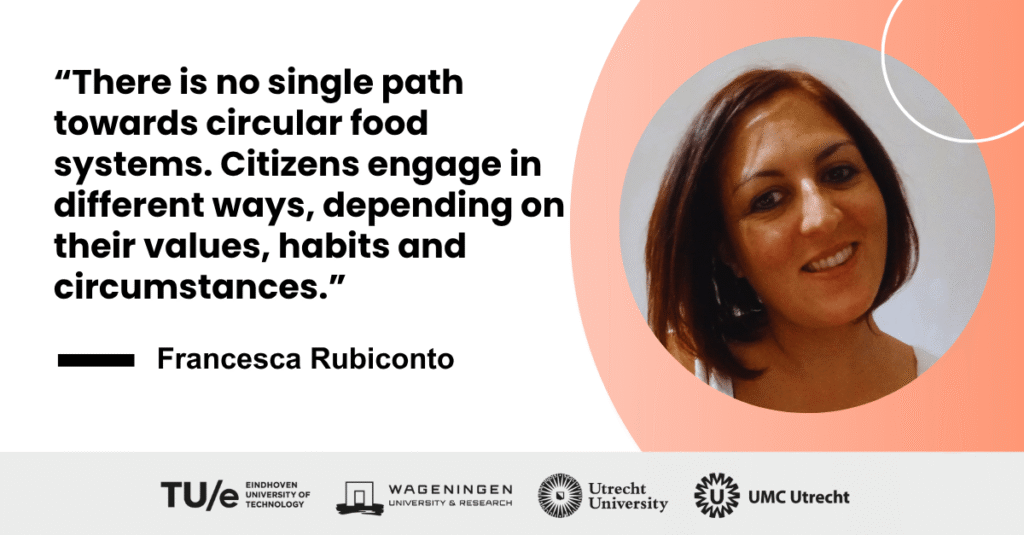
“There is no single path towards circular food systems. Citizens engage in different ways, depending on their values, habits and circumstances. Embracing this diversity can lead to more effective and inclusive interventions. Context also matters: practical barriers can prevent engagement, while social support can help overcome them. Finally, we need spaces where researchers from different disciplines, citizens and policymakers can work together to build not just a circular economy, but a circular society.” – Francesca Rubiconto
Why it matters
The findings offer practical starting points for municipalities and organisations that want to encourage circular food behaviour: rather than one-size-fits-all campaigns, interventions can be tailored to the cluster of behaviours a target group already practises.
The project also demonstrates what a modest seed grant can lead to: three years, over a thousand interviews and survey responses combined, and two peer-reviewed publications emerging from a project supported by EWUU seed funding.
Read the publications:
- Circular cities: Exploring motives and barriers to citizen engagement in circular food behaviour
- Diverse paths to circularity: Clusters of circular food behaviours and their predictors
Project team
This project was initiated by Francesca Rubiconto and Joana Wensing (both WUR), together with Eveline van Leeuwen (WUR), Pauline van den Berg (TU/e), and Choolwe Muzyamba (UU). The project has grown to include contributions from Liesbeth Lens (AMS), Maud Vink (WUR), Deborah van der Vlist (AMS) and Angel Lazaro (WUR).
Subscribe for more on circular society
Interested in how cities can shift towards circular food systems? Subscribe to the EWUU Alliance newsletter to receive insights from our research and initiatives delivered to your inbox.