Is transitioning to Circular Hospitals radical or logical?
Over the past year (2024–2025), the Institute for a Circular Society (i4CS) explored how futuring, art, and social design can accelerate the transition towards Circular Hospitals, hospitals that operate within planetary boundaries while protecting human health and equity. Existing approaches often focus on technology and efficiency yet overlook the social and imaginative dimensions of change. That’s why i4CS turned to the tools of art and design: to imagine what words alone cannot describe.
This article marks the start of a new series, Imagining Circular Futures for Hospitals, which follows the project from early exploration to concrete experimentation. We begin with the exploration phase, where the central question was: How can imagination make the transition towards circular healthcare more tangible and desirable?
The Exploration: Listening Across the Healthcare Chain
The Dutch healthcare sector accounts for 13% of the national material footprint and 7% of the national emissions, making it one of the most carbon-intensive sectors in the Netherlands. This contributes to climate change, biodiversity loss, and pollution all of which negatively impact human health and wellbeing.
Additionally, the sector’s reliance on critical raw materials and vulnerable supply chains poses risks to its resilience and sustainability. The Dutch Green Deal Sustainable Healthcare 3.0 highlights the urgency of transforming this sector into a climate-neutral, circular, and equitable system. Circularity in healthcare, however, is still in its infancy. To succeed, we need to address systemic challenges, engage diverse stakeholders, and foster collaboration.
To explore how to support this, Jopke Janmaat, Arte Groenewegen, and Florijn Dekkers conducted an exploratory project commissioned by i4CS. They studied existing circular initiatives and carried out in-depth interviews with people working across the healthcare chain: procurement officers, clinicians, waste managers, suppliers, activists, artists, designers, and researchers.
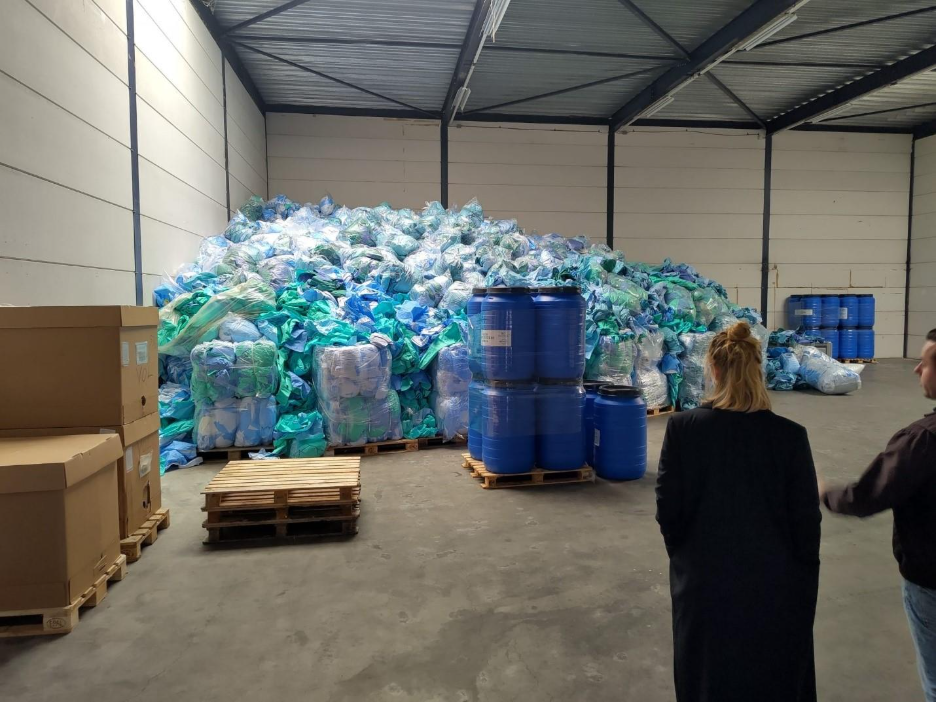
The team visited a waste processing plant for one of the interviews. Disposable waste from 2 weeks out of 15 hospitals, only blue wraps packaging material from sterilization sets in operating room, an imposing sight.
Why Imagination Matters
The exploration generated various insights. Firstly, it showed a shared sense of urgency: everyone recognises that the current system is unsustainable, but few can yet envision what a circular hospital might feel or function like.
Secondly, circular healthcare interventions can be perceived as radical and sometimes even disruptive to the status quo.
However, when seen in context, many circular solutions appear logical, natural extensions of healthcare’s core values such as health, equity, and sustainability.
To illustrate, the team used simple yet powerful thought experiment:
After using steel scissors once, do we throw them in the bin — as we do now — or do we sterilise and reuse them? And instead of flushing hospital toilets with clean drinking water — as we do now — why not safely reuse water that has already served another purpose?
Is that radical or logical?
Leveraging Art and Design
As highlighted by the Dutch Ministry of Education, Culture, and Science (see PONT), artists and designers can help to offer tools to imagine futures we cannot yet see, to materialise abstract ideas, and to create experiences that spark dialogue and reflection. In other words, they can help society distinguish between what only seems radical and what might, in fact, be the most logical path forward.
During the exploration, the team also found that many artworks, such as installations made from discarded medical materials, were perceived as powerful in revealing the absurdity of the linear “take-make-waste” system. However, far fewer projects ventured beyond critique to prototype new, circular possibilities.

The team working out their findings from the interviews.
This is where art meets design: art helps us feel the need for change, while design helps us build it. Moving from the radical to the logical requires both imagination and creation — envisioning new futures and testing them in practice.
Looking ahead
Based on insights gathered during the exploration phase, the team defined three follow-up initiatives to further explore creativity and imagination as drivers of change in healthcare:
- Social Design at the Dialysis Department (UMC Utrecht)
In collaboration with Studio Sociaal Centraal, this project explores circular water management in one of the hospital’s most resource-intensive departments: dialysis. Rather than developing technical solutions, it focuses on imagination and reflection, inviting staff, patients, and visitors to reconsider their relationship with water. What may first appear radical, such as reusing or revaluing water within hospital systems, can in fact be deeply logical when viewed through the lens of health, equity, and sustainability. As part of the project, an artwork has been be created to spark conversation about what a truly circular hospital could look like.
- Educational Opportunities through Challenge-Based Learning
Circular healthcare challenges have been integrated into challenge-based learning (CBL) courses across the four EWUU institutions (TU/e, WUR, UU, and UMC Utrecht). This approach creates win-win opportunities for students, educators, and real-world challenge owners.
Each of these initiatives marks a step in the Futuring for Circular Hospitals journey, moving from imagining to experiencing what circular healthcare could look like. Throughout the exploration phase, one central question kept returning: what do we consider radical, and what is simply logical when we align healthcare with the values of health, equity, and sustainability?
By engaging artists, designers, researchers, students and healthcare professionals, i4CS continues to explore this question in practice. The upcoming articles in this series will follow these projects, showing how creativity and imagination can turn what once seemed radical into the new logical foundation for circular, safe, and equitable hospitals.